

World Green Economy Summit 2026 to highlight international success stories through four main thematic pillars
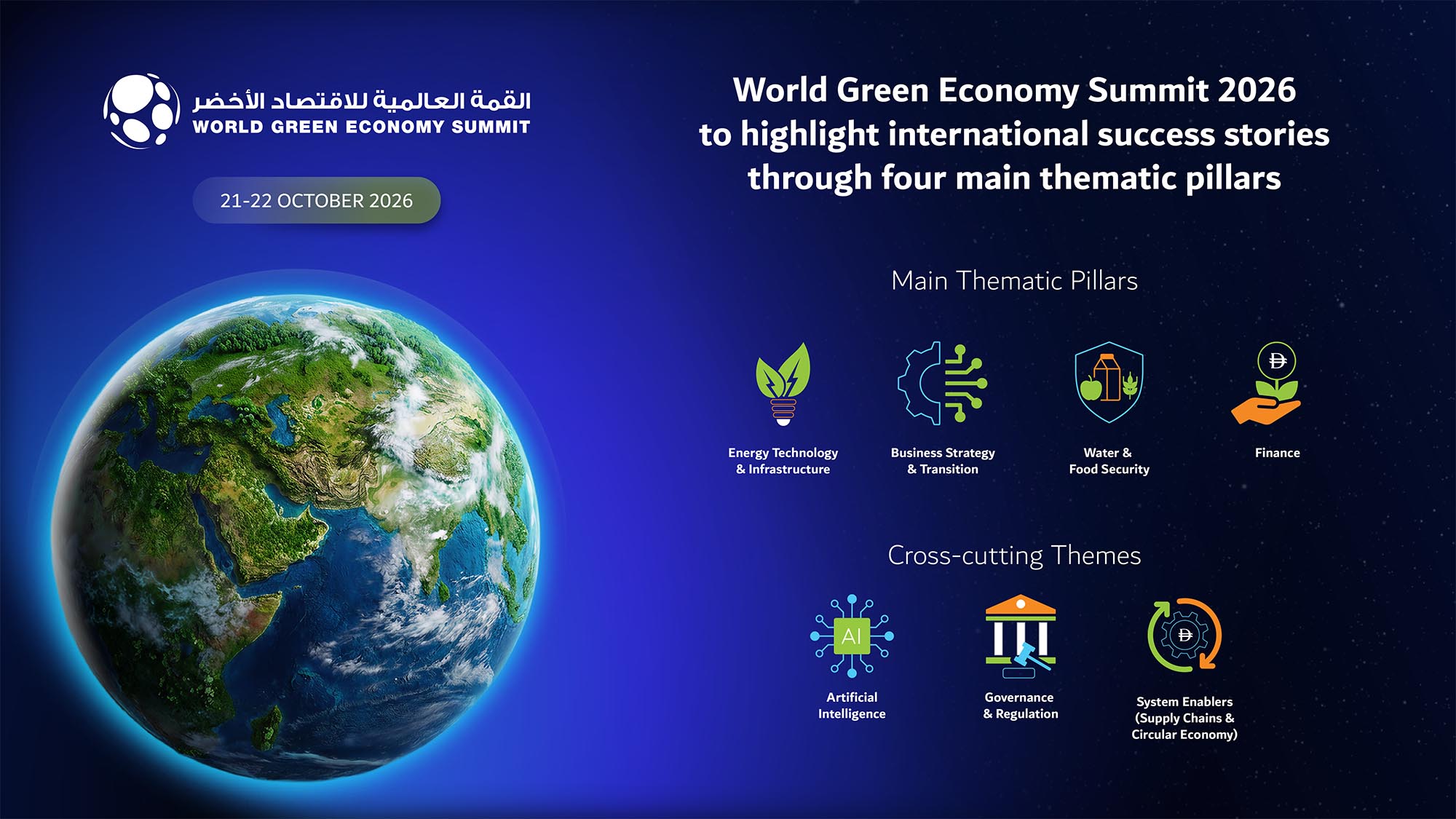
The summit will be held under the theme: From Success to Scale: Showcasing the Green Economy
Dubai, UAE, 30 July 2026: The UAE continues to strengthen its position as leading global hub for the green transition. Under the patronage of HH Sheikh Mohammed bin Rashid Al Maktoum, Vice President and Prime Minister of the UAE and Ruler of Dubai, the Dubai Supreme Council of Energy, Dubai Electricity and Water Authority and the World Green Economy Organization will organise the 12th edition of the World Green Economy Summit (WGES) on 21-22 October 2026 at the Dubai World Trade Centre.
This year’s theme is ‘From Success to Scale: Showcasing the Green Economy’. The summit will convene infrastructure developers, business leaders, resilience planners and capital providers to present proven and scalable solutions. Registration for the summit is open at https://www.wges.ae.
“This year, the World Green Economy Summit reflects the pivotal shift in the global sustainability dialogue. Successful models already exist. The summit moves the conversation beyond the need for climate action towards demonstrating how the transition is already taking place and how it can be expanded more rapidly and effectively. Bringing together experts from a wide range of countries, sectors and institutions, the summit will showcase the most effective and innovative approaches to advancing the green economy,” said HE Saeed Mohammed Al Tayer, Vice Chairman of the Dubai Supreme Council of Energy, MD and CEO of Dubai Electricity and Water Authority and Chairman of the World Green Economy Organization.
Main Thematic Pillars
WGES 2026 will focus on priority areas under four main thematic pillars: Energy Technology & Infrastructure; Business Strategy & Transition; Water & Food Security; and Finance. It will also address three cross-cutting themes: Artificial Intelligence (AI), Governance and System Enablers.
- Energy Technology & Infrastructure: This theme examines the role of energy infrastructure as the foundation for economic transformation at a time when global energy demand is surging, driven by electrification, industrial growth and the rapid expansion of AI-driven data centres. Sessions under this pillar will explore the rapid, large-scale deployment of clean power, the growing role of energy storage in strengthening the reliability of renewable energy systems and the contribution of emerging technologies – such as green hydrogen and nuclear energy – to a diversified energy mix that supports a low-carbon future.
- Business Strategy & Transition: This pillar examines how leading organisations are embedding sustainable growth into their core strategies as the green economy surpasses USD five trillion in annual value and continues to expand at twice the rate of conventional industries. Sessions will examine how businesses are capturing valuation premiums, redesigning business models around circular principles, addressing the green skills gap and navigating an evolving landscape of trade policies and carbon regulation. The focus will be on the factors that distinguish organisations leading the transition from those still adapting to it.
- Water & Food Security: This pillar addresses water and food security as fundamental economic and societal imperatives as climate change places increasing pressure on both resources. Sessions will highlight how technology and infrastructure are transforming vulnerabilities into strategic capabilities, from decarbonising water production and strengthening the water-energy nexus to deploying precision agriculture and climate-adapted food systems. They will also explore how climate resilience can be positioned as a long-term investment that supports economic stability, food security and sustainable growth.
- Finance: This pillar underscores the pivotal role of finance in advancing climate ambitions from planning to execution. Meeting global climate goals will require at least $6.3 trillion in annual investment from now until 2030, yet current investment remains well below that level at around $2.3 trillion. Sessions under this pillar will examine how that gap can be bridged through blended finance structures that reduce investment risk, green bonds and other innovative financing instruments that channel capital effectively, and real-world case studies that demonstrate the long-term value of climate investments. The focus is on how public and private sector financing can work together to fund the green transition at scale.
Cross-cutting Themes
These themes cut across every area of the summit, creating both challenges and opportunities. Addressing them effectively requires integrated and collaborative approaches.
- Artificial Intelligence: AI is both one of the green economy’s most powerful accelerators and one of its most rapidly evolving challenges. On one hand, AI enables smarter energy management, predictive analytics for environmental risk mitigation, improved emissions monitoring and enhanced agricultural productivity. On the other, AI-driven data centres are becoming major consumers of energy and water, with demand projected to increase significantly by 2030. WGES 2026 will outline the conditions under which AI becomes net positive for the green economy, from establishing energy efficiency standards for data centres to deploying AI-driven grid optimisation at scale.
- Governance: Effective governance is the critical link between ambition and implementation. Discussions throughout the summit will examine how policy and regulation influence decision-making in key markets. They will also explore the expansion of global carbon markets and their implications for trade and industry, as well as the evolving role of international climate agreements in advancing the green economy. The implementation of the Carbon Border Adjustment Mechanism (CBAM) from 2026 adds further urgency, particularly for industries such as aluminium, steel, cement and petrochemicals, which face increasing pressure to accelerate decarbonisation investments to maintain market competitiveness.
- System Enablers: Supply Chains & Circular Economy: The green transition depends on the transformation of systems that underpin economic activity. Supply chain resilience and circular economy models are accelerating across sectors, from energy infrastructure and manufacturing to food systems and water management. The global circular economy market was valued at $517.79 billion in 2025 and is projected to reach $888 billion by 2030, growing at a compound annual growth rate of 11.3%. Recycled materials also generate 80% lower emissions compared to primary extraction. WGES 2026 will examine how these system-level transformations support scalable, resilient and sustainable growth across the global economy.
Each year, the World Green Economy Summit brings together more than 3,300 participants representing over 30 countries, to discuss shared visions and expertise, and learn from more than 80 international speakers, including ministers, CEOs and innovators, as well as over 300 media representatives from global and regional outlets.